
Introduction
Are we alone in the universe? This is one of the biggest questions in modern science. The European Space Agency (ESA) is preparing to explore this question through its ambitious PLATO mission, a space telescope mission designed to discover and study planets orbiting stars beyond our Solar System.
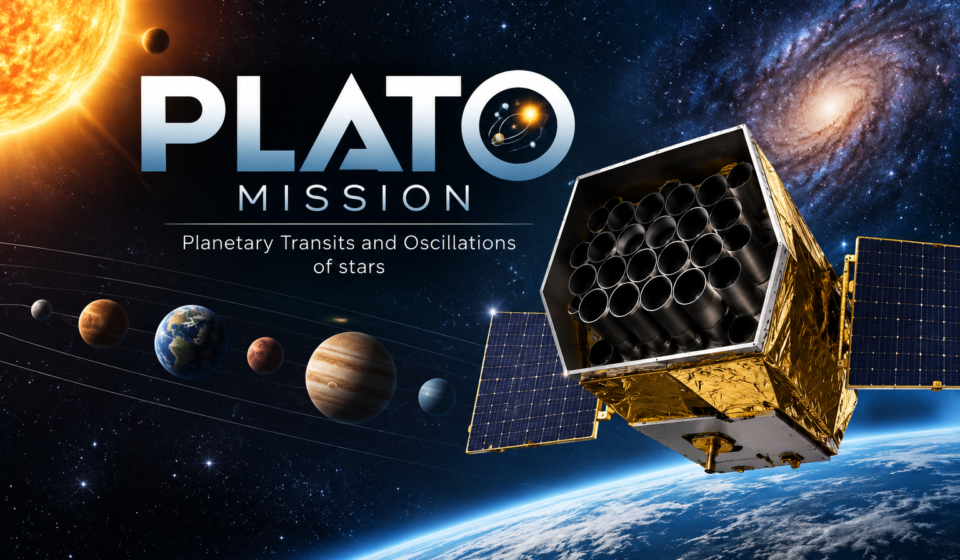
PLATO stands for PLAnetary Transits and Oscillations of stars. Its primary objective is to identify Earth-sized and other terrestrial exoplanets, especially those orbiting Sun-like stars within the habitable zone, where conditions may allow liquid water to exist.
Using 26 cameras and advanced observation techniques, PLATO will study thousands of stars and help scientists better understand planets, their host stars, and the possibility of habitable worlds.
What Is the PLATO Mission?
PLATO is a scientific space mission led by the European Space Agency. It is designed to discover extrasolar planets, also known as exoplanets, and accurately measure their properties.
Unlike a mission that simply looks for planets, PLATO will also investigate the stars around which these planets orbit. Understanding a star’s size, mass, and age helps scientists estimate the characteristics and evolutionary history of its planets.
According to ESA, the mission is planned to launch in March 2027 aboard an Ariane 6 rocket from Europe’s Spaceport in French Guiana. The spacecraft will operate around the Sun-Earth Lagrange point L2, approximately 1.5 million kilometres from Earth in the direction away from the Sun.
Key Features of the PLATO Mission
Some of the mission’s most important features include:
- 26 cameras: A multi-camera system designed to observe a large area of the sky.
- More than 200,000 stars: PLATO will monitor a large population of stars for signs of orbiting planets.
- Earth-like planet research: The mission will focus on terrestrial planets, including those in the habitable zones of Sun-like stars.
- Stellar analysis: It will study tiny variations in starlight to determine important properties of stars.
- Long-duration observations: Repeated measurements will help detect planets with longer orbital periods.
- International collaboration: ESA is leading the mission with contributions from European research institutions and industry partners.
These capabilities will help astronomers build a more detailed picture of planetary systems beyond our Solar System.
How Will PLATO Discover New Planets?
PLATO will primarily use a technique called the transit method to identify exoplanets.
When a planet passes in front of its host star from our point of view, it blocks a small amount of the star’s light. This produces a slight, measurable decrease in brightness.
By observing these changes repeatedly, scientists can identify potential planets and estimate several of their properties.
Step 1: Observe the Stars
PLATO’s cameras will continuously monitor selected regions of the sky and measure the brightness of many stars.
Step 2: Detect Changes in Brightness
When a planet crosses in front of a star, the star appears slightly dimmer. PLATO’s instruments will look for these small and recurring changes.
Step 3: Identify Potential Exoplanets
Repeated transit signals can reveal a possible planet and help estimate its orbital period, which is the time it takes to complete one orbit around its star.
Step 4: Measure Planetary Properties
Scientists will combine PLATO’s observations with other measurements, including ground-based observations, to determine properties such as planetary radius, mass, and density.
This information can help scientists distinguish between rocky planets and other types of worlds.
Why Is the Habitable Zone Important?
The habitable zone is the region around a star where temperatures could allow liquid water to exist on a planet’s surface, provided other necessary conditions are present.
Earth lies within the Sun’s habitable zone, making it a useful reference for studying potentially habitable planets.
However, being in the habitable zone does not automatically mean a planet supports life. Its atmosphere, surface conditions, magnetic environment, and many other factors can influence whether it is actually habitable.
PLATO will help identify planets that deserve further investigation by studying their size, orbit, and host stars. Its discoveries may provide valuable targets for future telescopes that investigate planetary atmospheres.
How Will PLATO Study Stars?
One of PLATO’s distinctive capabilities is its study of stellar oscillations, sometimes described as starquakes.
Stars can experience internal waves and oscillations that create tiny variations in their brightness. By analysing these variations, scientists can learn about a star’s internal structure.
This technique is called asteroseismology.
It can help researchers estimate a star’s mass, radius, and age. These measurements are important because planetary properties are often calculated relative to the star they orbit.
More accurate knowledge of a star can therefore lead to better estimates of the size, mass, and evolutionary history of its planets.
Where Will the PLATO Spacecraft Operate?
PLATO is planned to operate around the Sun-Earth L2 Lagrange point, approximately 1.5 million kilometres from Earth.
This region allows the spacecraft to maintain a suitable observing environment while remaining relatively stable with respect to the Sun and Earth.
Operating around L2 will support long-duration astronomical observations, helping PLATO measure small changes in stellar brightness with high precision.
When Will the PLATO Mission Launch?
As of October 2026, ESA lists the PLATO launch as planned for March 2027, using an Ariane 6 rocket.
Before launch, the spacecraft must complete its final preparations and testing to ensure that its instruments and systems can operate reliably in space.
Once operational, the mission is designed for an initial science phase of approximately four years, with the possibility of an extension.
Launch schedules can change, so readers should consult the European Space Agency’s official website for the latest updates.
How Is PLATO Different From Other Space Telescopes?
Several previous and current missions, including NASA’s Kepler and TESS missions and ESA’s CHEOPS mission, have contributed to exoplanet research.
PLATO will build on their achievements, with a particular emphasis on terrestrial planets orbiting bright, Sun-like stars and on precisely characterising the properties of their host stars.
Its combination of 26 cameras, long-duration observations, and asteroseismology is designed to improve our understanding of planets and their evolution.
PLATO’s findings will also complement observations from other space and ground-based telescopes, which can investigate planetary masses and atmospheres in greater detail.
Why Is the PLATO Mission Important?
PLATO could make an important contribution to several major scientific questions:
- How common are Earth-sized planets around stars similar to the Sun?
- How do planetary systems form and evolve?
- How does a planet’s age relate to its physical characteristics?
- Which planets may have conditions suitable for liquid water?
- How common are planetary systems similar to our own?
The mission will not directly prove that extraterrestrial life exists. Instead, it will provide more precise information about planets that may be suitable for further habitability research.
Its observations could help scientists understand whether our Solar System is unusual or one example of a much broader population of planetary systems.
Conclusion
The PLATO mission represents an important step in the search for Earth-like planets beyond our Solar System. By monitoring hundreds of thousands of stars, detecting planetary transits, and studying stellar oscillations, ESA aims to improve our understanding of planets and the stars they orbit.
Although discovering a planet in the habitable zone does not guarantee that life exists there, PLATO could identify promising worlds for future scientific investigation.
As the planned 2027 launch approaches, the mission brings astronomers closer to answering a fundamental question: How many worlds like Earth exist in our galaxy?
Official References
- European Space Agency: https://www.esa.int/Science_Exploration/Space_Science/Plato
- ESA PLATO Factsheet: https://www.esa.int/Science_Exploration/Space_Science/Plato_factsheet
- ESA PLATO Mission Overview: https://www.cosmos.esa.int/web/plato
SEO Keywords
PLATO mission, ESA PLATO mission, PLATO space telescope, Earth-like planets, exoplanet discovery, habitable planets, European Space Agency, planetary transits, asteroseismology, space exploration.